
Si votre dépoussiéreur continue de se boucher, les filtres ne sont pas les méchants, mais leur conception. Dans presque tous les cas que nous étudions, la cause fondamentale remonte à l'une des cinq erreurs suivantes : un rapport air/tissu sous-dimensionné, une faible vitesse des conduits, un média filtrant inapproprié, une trémie qui ne peut pas se vider ou un nettoyage par impulsions qui ne nettoie pas réellement. Corrigez la conception et le colmatage disparaît.
Erreur 1 : le rapport air/tissu est trop agressif
Il s’agit de la raison la plus courante pour laquelle les cartouches s’éteignent en quelques semaines plutôt qu’en années. Le rapport air/tissu (A/C) est le volume d’air poussé à travers chaque pied carré de média filtrant. Trop élevé, vous projetez de la poussière dans le support plus rapidement que le nettoyage par impulsion ne peut la libérer.
Pour les poussières fines, collantes ou submicroniques (pensez aux fumées de soudage, aux poudres pharmaceutiques ou à la poussière des électrodes de batterie au lithium), vous voulez un rapport A/C plus proche de 2:1. Pour la poussière granulaire fluide comme le bois ou les céréales, vous pouvez pousser 3,5:1 sans problème. Les concepteurs spécifient souvent 4:1 ou plus pour économiser sur la taille du collecteur, et le client paie pour toujours en remplacement de filtres.
Par exemple, un fabricant de composants de batterie avec lequel nous travaillions remplaçait les cartouches toutes les 10 semaines. Le collecteur avait été dimensionné à 3,8:1 pour une poussière avec une densité apparente inférieure à 20 lb/ft³ et une fraction lourde submicronique. La réduction du rapport à 2,2:1 en ajoutant une zone de filtre a prolongé la durée de vie de la cartouche au-delà de deux ans. Les mathématiques ne sont pas facultatives, c'est la base. Notre guide complet sur la conception de systèmes de vide industriel explique le calcul en détail.
Erreur 2 : la vitesse du conduit qui laisse tomber la poussière avant qu'elle n'arrive
Voici un tueur silencieux : des conduits dimensionnés pour la chute de pression au lieu de la vitesse de transport. Si l’air circule trop lentement dans le conduit, la poussière s’y dépose. Ensuite, vous obtenez des blocages en amont du collecteur – et le collecteur lui-même voit des poussées de lourdes limaces de poussière qui submergent les filtres.
Les vitesses de transport cibles dépendent de la poussière :
- Vapeurs légères et fumée : 2,000–2,500 ft/min
- Fines poussières sèches (farine, polissage) : 3,000–3,500 ft/min
- Poussières industrielles moyennes (meulage, bois) : 3,500–4,000 ft/min
- Poussières lourdes ou humides (copeaux métalliques, sciure humide) : 4,500+ ft/min
Les conduits surdimensionnés sont le coupable habituel. Un entrepreneur choisit un diamètre plus grand pour réduire la pression statique, la vitesse chute en dessous de 3 000 pieds/min et six mois plus tard, les parcours horizontaux sont à moitié remplis de poussière déposée. Les branches sous-dimensionnées constituent le problème inverse : elles étouffent le flux aux points de capture, de sorte que le capot n'aspire pas du tout la poussière. Quoi qu’il en soit, c’est le collectionneur qui est blâmé.
Erreur 3 : le mauvais média filtrant pour la poussière
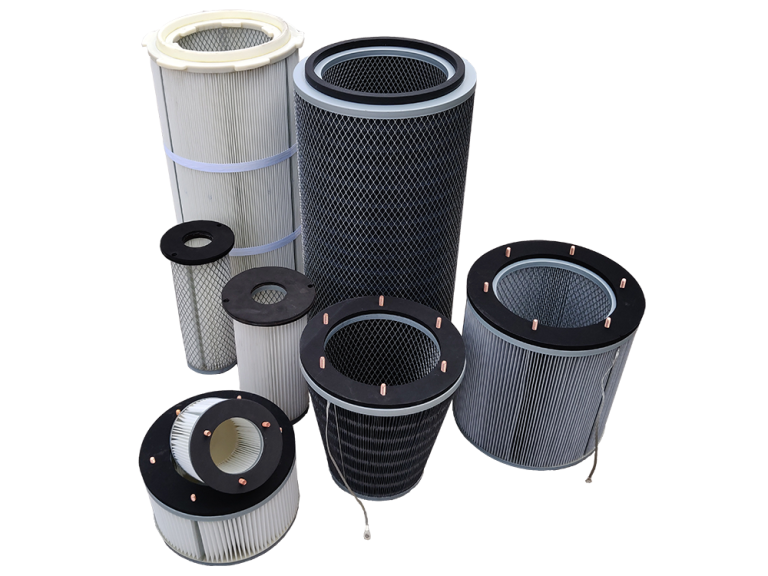
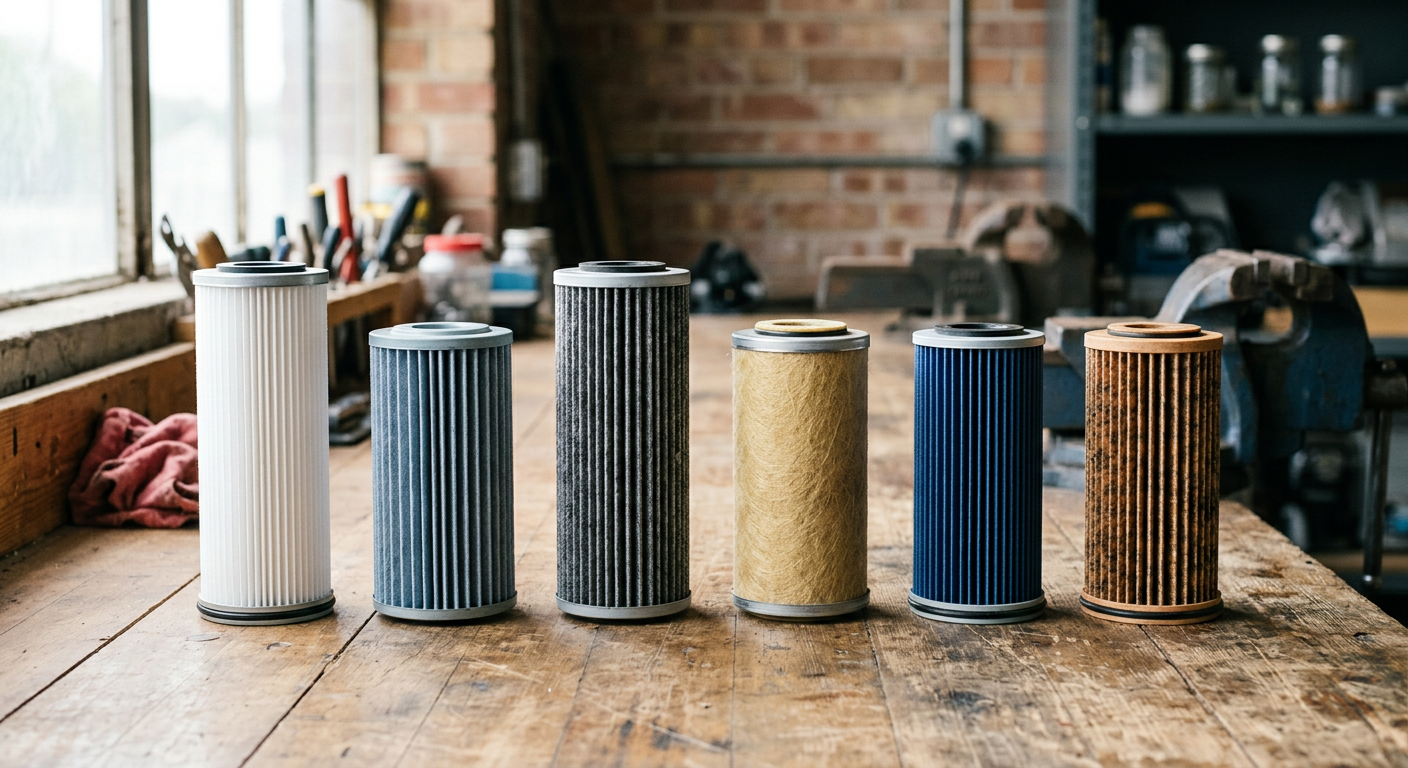
Toutes les poussières ne se comportent pas de la même manière, et les médias filtrants non plus. Utilisez un polyester filé-lié standard sur des fumées de soudage huileuses, et il deviendra aveugle au bout d'un mois car l'huile pénètre dans les fibres et le nettoyage par impulsion ne peut pas le détacher. Utilisez un support non traité sur des poussières hygroscopiques comme le sucre ou certains produits chimiques, et une journée humide transforme vos cartouches en béton.
Faites correspondre les médias avec la poussière :
- Membrane PTFE : submicron, sticky, or moist dust — surface loading means pulses release the cake cleanly
- Nanofibre : fine metallic dust, welding fume, pharma — high efficiency at low pressure drop
- Antistatique/conducteur : mandatory for combustible dust (you don't want an ignition source inside the collector)
- Revêtement oléophobe : oil mist or fume with oily carryover
Ceci est particulièrement critique dans les industries où les propriétés de la poussière changent de façon saisonnière ou en fonction du processus. Vous trouverez une analyse pratique et approfondie à ce sujet dans notre article sur le comment fonctionne le nettoyage par jet pulsé à l'intérieur d'un dépoussiéreur : le choix du support et les performances de nettoyage sont directement liés.
Erreur 4 : une trémie qui ne peut pas réellement se décharger
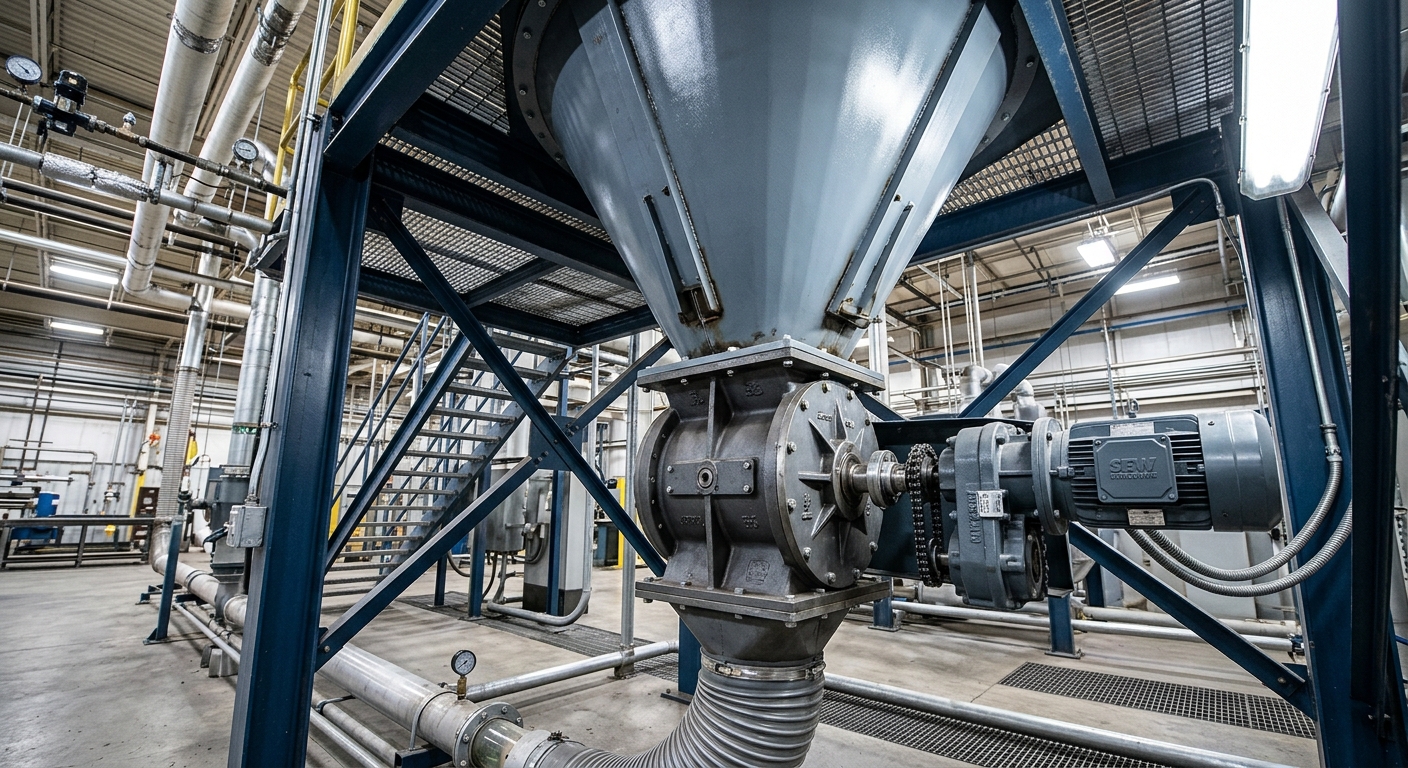
Les dépoussiéreurs ne sont pas des réservoirs de stockage. Mais de nombreuses installations les traitent de cette façon. Si la trémie ne peut pas se vider en continu – ou si le point de décharge est sous-dimensionné, mal incliné ou s'appuie sur une vanne rotative bloquée – la poussière s'accumule, atteint les sacs filtrants ou les cartouches et obstrue le tiers inférieur de votre zone de filtre. Le nettoyage par impulsions souffle ensuite simplement la poussière vers davantage de poussière.
Trois échecs de conception que nous constatons à plusieurs reprises :
- Pente de la trémie inférieure à 60° : Fine cohesive dusts bridge instead of flowing. Sixty degrees is the practical minimum; 70° is safer for anything sticky.
- Dispositif de décharge sous-dimensionné ou absent : A rotary airlock has to move as much dust as the collector pulls in. If yours trips on overload, it's too small.
- Collecte manuelle des fûts laissés pleins : Operators forget to empty it, dust backs up into the hopper, filters blind from below.
Une usine d’ingrédients alimentaires que nous avons soutenue souffrait d’un aveuglement chronique des filtres tous les lundis matins. Cause première? Le tambour s'est rempli vendredi après-midi et est resté pendant le week-end pendant que le collecteur continuait de fonctionner. Un capteur de niveau et un tambour plus grand ont résolu un problème que trois changements de filtre n'avaient pas résolu.
Erreur 5 : un nettoyage par impulsions qui ne nettoie pas vraiment
Les systèmes à jet pulsé semblent simples : un jet d'air comprimé fléchit le filtre et fait tomber la poussière de la surface. Lorsqu'ils échouent, cela est généralement invisible jusqu'à ce que les filtres soient déjà aveuglés. Les coupables les plus fréquents :
- Pression d'air comprimé trop faible : You need 90–100 psi at the tank. Shared plant air dropping to 70 psi during peak use means your pulse barely ripples the media.
- Air comprimé humide et huileux : Moisture and oil coat the filter from the inside out. Install a refrigerated dryer and coalescing filter on the collector's air supply — not optional.
- Nettoyage sur minuterie fixe au lieu de pression différentielle : Timer-based cleaning either over-cleans (wearing out media) or under-cleans (letting cake build up). On-demand cleaning triggered by ΔP keeps filters stable around 2–4 inWG.
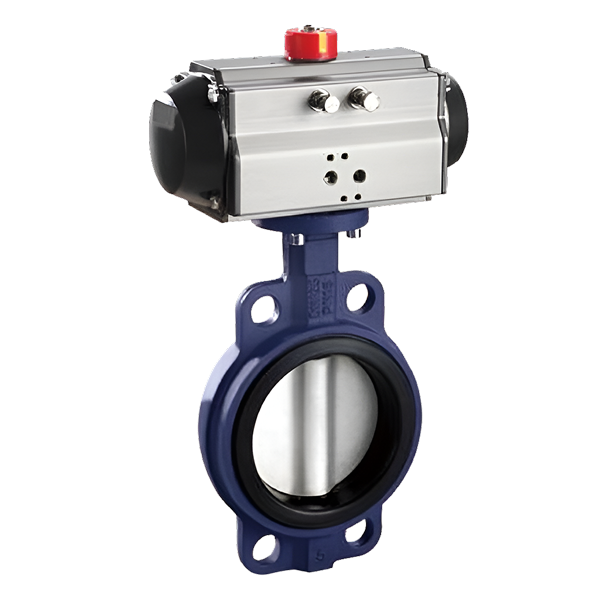
- Fuite des vannes à membrane : A valve that doesn't fully close bleeds air continuously and never delivers a real pulse.
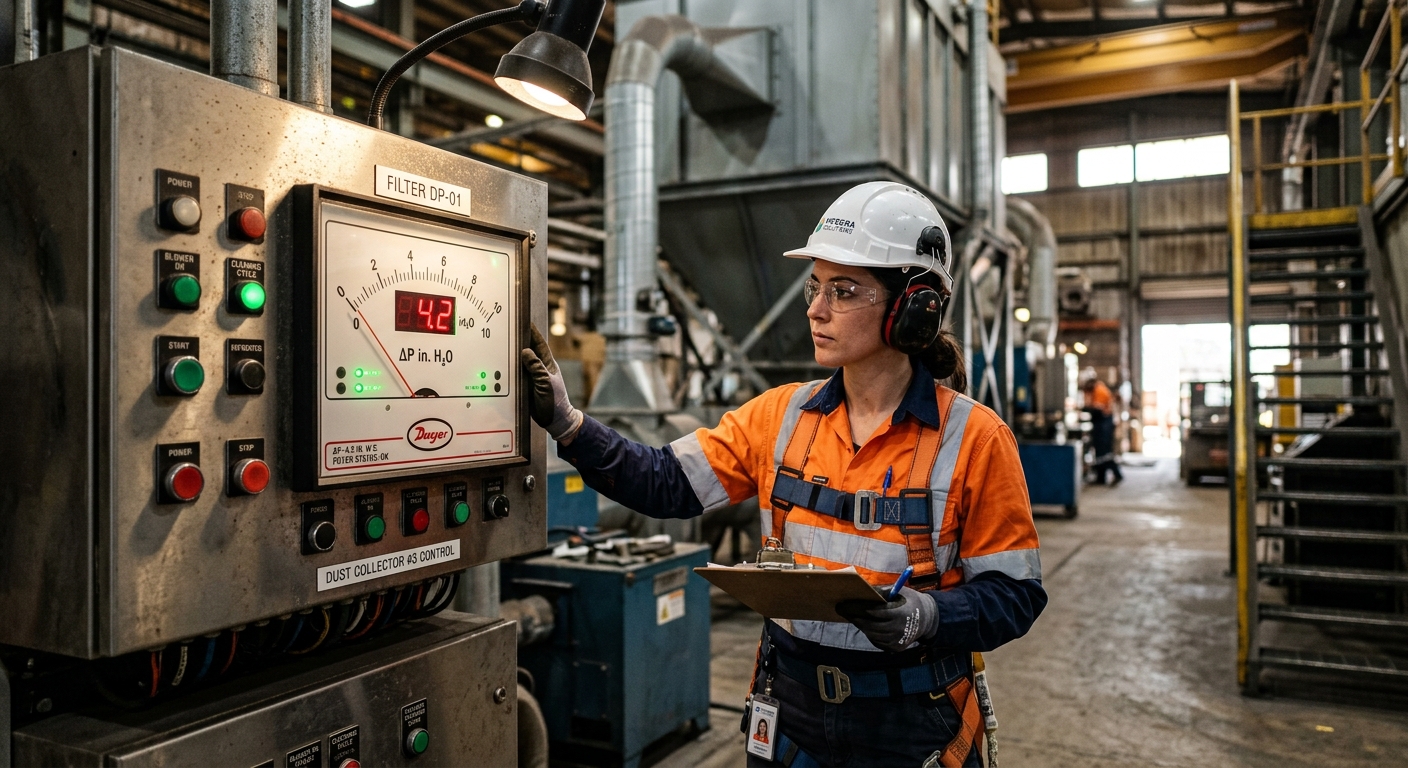
Fonctionnement du clapet anti-retour avec un diagnostic simple : surveillez le manomètre différentiel pendant un cycle de nettoyage. Un pouls sain diminue instantanément le ΔP de 0,5 à 1,5 inWG. Pas de chute ? Pas de nettoyage.
Comment diagnostiquer quelle erreur est la vôtre
Avant d'échanger des filtres ou d'appeler un fournisseur, exécutez cette séquence de diagnostic rapide :
- Enregistrez la pression différentielle pendant une semaine. A steadily climbing ΔP that never recovers points to cleaning failure or wrong media. A ΔP that spikes during production and drops during idle points to sizing or duct velocity.
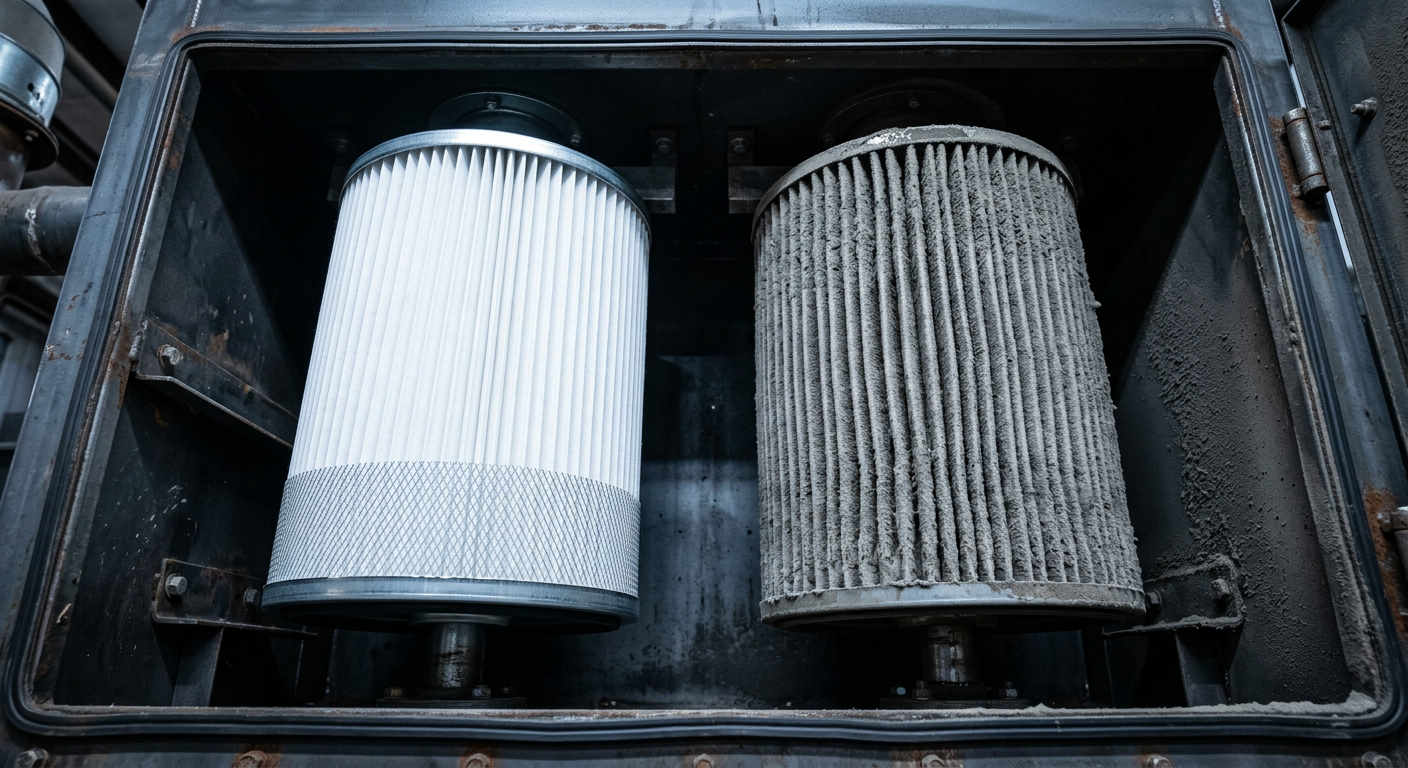
- Ouvrir le collecteur froid. Look at the filters. Even cake? Sizing issue. Dust stuck in pleats? Media issue. Dust piled in the hopper? Discharge issue. Oily residue? Compressed air or process issue.
- Mesurer la vitesse du conduit en deux ou trois points with a pitot tube. Anything under your target velocity is a problem, full stop.
- Vérifier la pression de l'air comprimé au niveau du collecteur pendant une impulsion, not at the plant compressor. You'll often find a 20–30 psi drop you didn't know existed.
Quatre-vingt-dix pour cent des problèmes de colmatage chroniques entrent dans une ou deux de ces catégories. Les dix pour cent restants impliquent généralement des changements de processus – un nouveau matériau, un débit plus élevé ou un changement d’humidité – qui ont poussé une conception limite au-delà des limites. Notre article sur la maximisation de l'efficacité de la collecte des poussières couvre le cadre d'audit complet.
Quand le colmatage devient un problème de sécurité
Le colmatage chronique n’est pas seulement un problème de maintenance : c’est un indicateur de risque. Les filtres aveugles augmentent la pression statique, ce qui force les ventilateurs plus fort, ce qui augmente les vitesses internes, ce qui peut réentraîner la poussière et, dans les applications de poussières combustibles, créer les conditions exactes qui alimentent les déflagrations. Un collecteur bouché qui chauffe sur une poussière combustible est une horloge à retardement.
Si vous manipulez des métaux, des sucres, des poussières organiques, des plastiques ou des matériaux de batterie, les symptômes de colmatage devraient également déclencher une vérification de la protection contre les explosions. Vérifiez que les vannes d'isolement, la ventilation et la suppression sont toujours correctement dimensionnées pour les pressions de fonctionnement actuelles. Notre aperçu des tests de suppression des explosions et l'article sur les vannes d'isolement contre les explosions expliquent ce qu'il faut rechercher.
Réparer le problème du premier coup
Voici la vérité honnête : la plupart des problèmes d'encrassement ne peuvent pas être résolus en remplaçant les filtres par une « meilleure » marque. Si le collecteur est sous-dimensionné, si les conduits sont incorrects ou si la trémie ne peut pas se vider, les filtres haut de gamme échoueront tout simplement à un coût plus élevé. Les vrais correctifs impliquent généralement un ou plusieurs de ces éléments :
- Recalcul du rapport A/C et ajout d'une zone de filtre (souvent en ajoutant un module ou en passant à un média plus efficace)
- Réduire les branches pour atteindre une vitesse de transport appropriée
- Passage à des supports PTFE ou nanofibres adaptés à la poussière réelle
- Remplacement ou redimensionnement du dispositif de décharge et ajout d'une détection de niveau
- Améliorer l'approvisionnement en air comprimé et passer au nettoyage par impulsions à la demande
Si vous êtes confronté au même problème de colmatage chaque trimestre, cela vaut la peine de jeter un deuxième regard sur la conception plutôt que de continuer à acheter des filtres. Les ingénieurs de Villotech conçoivent, modernisent et dépannent des systèmes de dépoussiérage dans les installations de soudage, de batteries, pharmaceutiques, alimentaires et de semi-conducteurs. Contactez-nous via notre page de solutions et nous vous aiderons à identifier laquelle des cinq erreurs vous coûte du temps de disponibilité.